

Solid Phase Extraction Spe
- Innovative Product Series
-
Sample pretreatment
- Column Plate For Nucleic Acid Extraction
- Solid Phase Extraction Spe
- Tip SPE
- Medium Pressure Chromatography Columns High Pressure Chromatography Columns
- Affinity Chromatography Ac
- Pre Treatment Columns For Ion Chromatography
- Blank Flash Columns
- Liquid Liquid Extraction Sle
- Dispersive Solid Phase Extraction Quechers
- Serum Pipette
- Cell Culture
- Filtering Apparatus
- Laboratory filters
- Automated intelligent devices
- Maintenance Of Technics
- In vitro diagnostic reagents and consumables

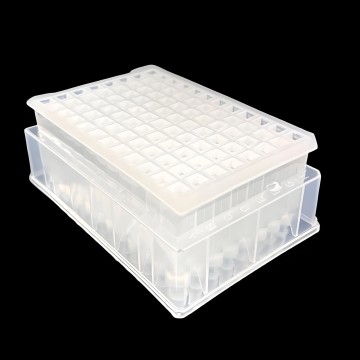
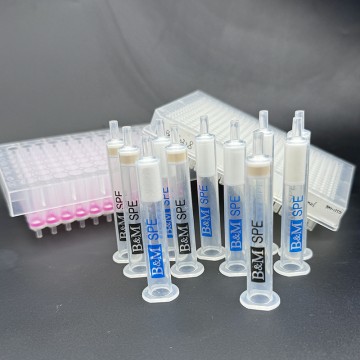
CN Solid Phase Extraction Column Plates
B&M® CN is a cyanopropyl silica gel-based extraction column that can be used as a non-polar adsorbent to extract polar and non-polar molecules from aqueous solutions, as well as polar molecules from relatively non-polar solvents. In addition, cyanopropyl acts as a complex ligand to enrich some metal ions in aqueous solution.
Cyanopropyl is a weakly hydrophobic filler of the silica matrix and can be used as a direct or reverse phase adsorbent. Under the conditions of the reversed phase, nonpolar or slightly polar acidic, neutral and basic compounds are extracted from aqueous solutions. Under direct phase conditions, polar compounds are extracted from nonpolar organic solutions. In addition, cyanopropyl acts as a complex ligand to enrich some metal ions in aqueous solution. For strong hydrophobic substances that bind irreversibly at the stationary C18 phases, the stationary CN phases are a more suitable choice. Equivalent to Waters Sep-Pak CN.
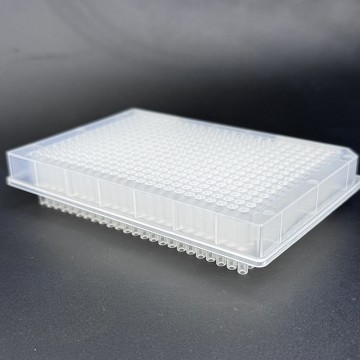
C18W Solid Phase Extraction Column Plates
The B&M® C18W (Uncapped) is a silica gel-based, non-capped reversed-phase extraction column C18, where a higher number of silanolic functional groups on the surface provides additional polar interactions. Nonpolar compounds are extracted through hydrophobic interaction.
At the same time, the activity of the silanol groups provides a better retention capacity for some drug metabolites and major compounds compared to capped C18, so that the retention mechanism includes moderately nonpolar and polar secondary interactions.
The column retains most organic compounds with a wide range of selectivity, making it a versatile stationary phase for the extraction of polar and non-polar compounds.
This column is equivalent to Aglient Accu Bond C18, Bond elute C18 OH.
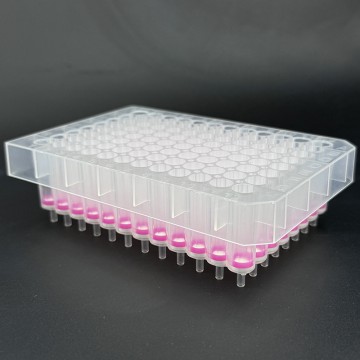
C18Q Solid Phase Extraction Column Plates
The B&M® C18Q (Hydrophilic) is a hydrophilic, silica gel-based reversed-phase extraction column with full coverage and excellent stability. It can use pure water as a mobile phase and is capable of separating acidic, neutral, and basic organic compounds, as well as many pharmaceuticals and peptides, among others.
Like capped C18, it is widely used to purify, extract, and concentrate contaminants in environmental water samples, such as polycyclic aromatic hydrocarbons (PAHs), pesticide residues in food and beverages, and drugs and metabolites in body fluids. It is also used to desalinate aqueous solutions prior to ion exchange. In biological applications such as peptide and DNA extraction, its performance is superior to classic C18.
This column is equivalent to Aglient Accu Bond C18, Bond elute C18 OH.

C18 Column Plates for Solid Phase Extraction
B&M® C18 The most commonly used silica gel array columns for reversed-phase SPE, a larger number of silanolic functional groups on the surface provides additional polar interaction. Non-polar compounds are extracted through hydrophobic interactions.
In addition, enhanced polar interactions for the main compounds compared to other adsorbents.
The column retains most organic compounds and has broad selectivity for use as a general-purpose solid-phase extraction column for the recovery of both polar and non-polar compounds.
C8 Column Plates for Solid Phase Extraction
B&M® is a moderately hydrophobic filler for a reversed-phase silica matrix that is similar in adsorption to the C18 bond and holds nonpolar compounds together mainly due to the hydrophobic interactions of nonpolar carbon bonds.
Because the carbon bond of C8 is shorter than that of C18, the retention of nonpolar compounds is weaker than that of C18, which helps to elut samples with excess adsorption of nonpolar compounds.
If the use of C18 makes it difficult to eludate nonpolar objects, C8 can be used instead.